
Construction Site Worker Safety Alarm
Construction sites are among the most hazardous working environments in Europe. Workers operate at height, often in noisy and physically demanding conditions, where a single misstep can have catastrophic consequences. When something goes wrong, the speed and clarity of the emergency response can determine whether a worker survives. This use case explores how automatic fall detection technology works in practice on a live construction site, and what it means for security companies looking to deliver genuinely protective services to their clients: construction site worker safety alarm.
When a Scaffolding Fall Happens, Every Second Exposes Who Owns the Response
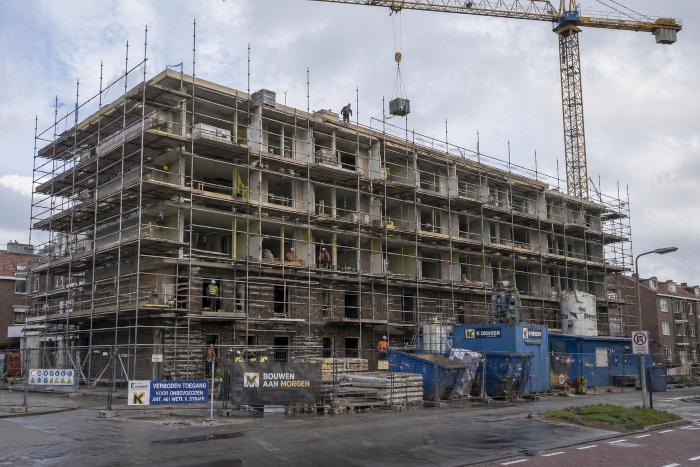
Picture a mid-sized construction project. A residential development on the edge of a Dutch city. Forty workers on site across any given day. Scaffolding reaching six storeys. Concrete work happening at the base while trades operate above. The site manager is responsible for everything happening across that footprint.
Construction consistently ranks among the top sectors for fatal accident incidence rates across EU member states. Mining and quarrying recorded 10.8 fatal accidents per 100,000 employed people in 2023, according to Eurostat, and construction sits in the same bracket. These are not abstract statistics for the people running these sites. They are daily realities that carry serious legal, moral, and operational weight.
The workers on this site start early. By 7am, scaffolders are already moving materials between levels. A crane operator works from a cab ten metres off the ground. First-aid trained emergency responders, designated ERT (BHV in Dutch) personnel under Dutch law, are present on site. But no one can be everywhere at once. And when a worker falls, the first moments matter most.
The site manager knows this. He has done the toolbox talks. He has read the accident reports from other sites. What he does not have, until now, is a system that detects a fall automatically, without relying on a colleague nearby to see it happen, or the injured worker to press a button they may no longer be able to reach.
How Automatic Fall Detection Works on a Live Construction Site
It is a Tuesday morning. A scaffolding worker is moving a board on the fourth level when he loses his footing. He falls. The impact is hard. He is on his back, unable to move, and the site noise around him means no one nearby hears anything unusual.
He is wearing a TWIG personal alarm device, issued to him at the start of the shift as part of the site’s safety protocol. The device detects the fall automatically using built-in sensors. Within seconds, it triggers an alarm. No button press required. The worker does not need to be conscious or alert for the system to activate.
The alarm transmits immediately. The site’s designated emergency responders, the ‘BHV’-team, receive a notification with the worker’s location on their own TWIG or smartphone. The site manager, who is in the on-site office, receives the same alert at the same moment. Location data pinpoints where on the scaffolding structure the fall occurred. There is no delay waiting for a third party to interpret the situation and decide whether to escalate.
The site manager calls 112. He knows exactly where the worker is and can describe the situation clearly to the dispatcher. Two ERT responders are already moving towards the location. The crane operator, alerted through the site’s communication chain, brings the elevated work platform to assist with access to the injured worker.
Professional emergency services arrive. The ERT has already stabilised the situation. The worker receives care within minutes of the fall. The response was fast not because everyone was lucky, but because the system was designed to remove uncertainty from the first critical moments.
Managing devices across a site like this, assigning them to workers, monitoring connectivity status, and tracking which devices are active on any given shift, is handled through a single platform. A well-structured device management system means the site manager’s administrator can handle all of this without needing technical support for every change.
Construction sites are also often located in areas where mobile coverage is inconsistent. Reliable alarm transmission depends on connectivity that is built for difficult environments. How that connectivity is managed and maintained is a practical consideration that separates a solution that works from one that only works sometimes. A purpose-built approach to SIM and connectivity management ensures that when a worker falls in a partially enclosed structure or on the edge of a coverage zone, the alarm still gets through.
The Third-Party Control Room Problem: Good Margins, Zero Visibility
Many security companies currently deliver alarm services through third-party control rooms. The arrangement looks reasonable on paper. The integrator handles the infrastructure. The security company earns a margin. Clients get a monitored service.
But consider what happens on the construction site in the scenario above. The alarm triggers. It routes to a third-party dispatcher. That dispatcher follows their protocol. They make a judgement call about escalation. The site manager is not in that conversation. The security company that sold the service is not in that conversation either. They find out what happened when the client calls them, frustrated, asking why the response took as long as it did.
The problem is not usually incompetence. Most third-party control rooms are staffed by capable people. The problem is that when something genuinely serious happens, the security company has no visibility and no control over a service that carries their name. One slow response, one miscommunication during a genuine emergency, and a client relationship built over years can end in a matter of days.
This is the gap that a white-label personal safety platform closes. Not by adding complexity, but by returning control of the response chain to the security company that owns the client relationship.
What Full Control Over the Response Chain Actually Looks Like
When a security company operates the full response chain under its own brand, the dynamic changes entirely. The alarm from the construction site worker goes directly into the security company’s monitoring environment. Their operators see it. Their protocols govern the response. Their client hears from them directly, not from a third party the client has never spoken to before.
For the construction client, this means the company they trust is actually running the service they are paying for. The site manager can call one number. He speaks to people who know his site, know his team structure, and know his escalation preferences. That is a different service experience from receiving a call from a generic control room following a standard script.
For the security company, this means no more situations where they are phoning their integrator at midnight trying to find out what their own service is doing. The monitoring dashboard shows alarm status, location, response actions, and resolution in real time. If a client calls asking what happened, the account manager already knows.
The platform that enables this is not built for one use case. It powers the same logic across industries, including retail, healthcare, education, and manufacturing, with the same consistent experience under the security company’s own branding. That scalability matters when the goal is to grow beyond a single client or a single sector.
Building a Scalable Personal Safety Service for Construction Clients Under Your Own Brand
The lone worker safety solutions market in Europe reached €145 million in value in 2024, according to Berg Insight. That figure is projected to grow to €180 million by 2029. The combined market value across Europe, North America, and Australia and New Zealand reached €285 million in 2024. The demand is growing, and construction is one of the sectors driving that growth, given its regulatory requirements, high-risk environment, and increasing pressure on site managers to demonstrate duty of care.
For a security company looking to move from time-and-materials contracts towards predictable recurring revenue, construction safety is a compelling entry point. Sites have clear, quantifiable risks. Procurement decisions are often made by one or two people. The value of a system that reduces response time and demonstrates compliance is easy to articulate in practical terms.
A white-label personal safety platform allows a security company to deliver this service under its own name, without building the underlying technology itself. Devices are configured, assigned, and managed through a single interface. Clients access a branded experience. The security company retains full visibility over every alarm, every response, and every device in the field.
When presenting this proposition to a construction client, the conversation does not need to start with technology. It starts with the site manager’s existing problem. His workers operate at height. His ERT cannot be everywhere. If something happens and the response is slow, the consequences are legal, financial, and deeply personal. A construction site worker safety alarm system that detects falls automatically, notifies the right people immediately, and routes through a chain the site manager already trusts is not a hard sell. It is the answer to a problem he already knows he has.
When security companies present this to clients, the key points to emphasise are the automatic fall detection that removes the dependency on the worker to trigger the alarm, the direct notification to ERT and site management without third-party routing, the location accuracy that enables an immediate and targeted response, and the operational simplicity of managing multiple devices across one or many sites from a single platform. Common objections around complexity and maintenance are addressed by the fact that device management, connectivity, and software updates are handled through the platform, not by the construction client’s own staff.
The security company becomes not a hardware supplier, but the company that kept someone’s workers safe when it mattered. That is the relationship that drives retention, referrals, and the kind of contract renewal conversations that do not need a tender process.
Frequently Asked Questions
What is automatic fall detection and how does it work on a construction site?
Automatic fall detection uses sensors built into a personal alarm device to identify the motion pattern and impact associated with a fall. When the device detects this, it triggers an alarm without requiring the worker to press a button. This matters on construction sites because an injured worker may be unable to activate a manual alarm. The alarm transmits location data and an alert to designated responders immediately after detection.
How does a personal alarm system help construction sites meet their duty of care obligations?
Construction site operators have a legal obligation to protect workers from foreseeable harm. A personal alarm system with automatic fall detection demonstrates active measures to detect and respond to accidents quickly. It supports compliance with health and safety regulations by creating an auditable response chain, reducing the time between an incident and professional intervention, and providing documentation of how each alarm was handled.
Can the system work across large or complex construction sites where coverage may be inconsistent?
Coverage is a genuine practical concern on construction sites, particularly in partially enclosed structures or locations at the edge of mobile network coverage. Purpose-built connectivity management ensures that devices maintain reliable transmission in these environments. The platform is designed to handle patchy coverage scenarios without requiring the site to invest in its own network infrastructure.
How does a security company manage TWIG devices across multiple construction clients?
A central device management platform allows a security company to assign, monitor, and update devices across all clients from a single interface. Each client’s devices are managed separately, so a problem on one site does not affect others. This means a security company can scale from a handful of devices on a single site to hundreds across multiple clients without adding significant operational overhead.
What makes this different from simply buying a third-party alarm monitoring contract?
A third-party monitoring contract hands control of the response chain to an external organisation. The security company loses visibility into what happens after an alarm triggers, and relies on another company’s protocols and priorities. A white-label platform returns that control. The security company’s operators manage the response, the client interacts with the company they trust, and every alarm, response, and resolution is visible to the security company in real time.