
Night Security Guard Safety
When the Camera Shows Something Moving: A Night Watchman’s Real Scenario
Night security is one of the most exposed roles in the entire security sector. A lone guard, a large site, and a single moment when something goes wrong. This use case explores exactly that scenario: a night watchman monitoring a warehouse facility who spots a break-in attempt on camera and needs immediate backup. It is a situation that happens more often than incident reports suggest, and it exposes a critical gap in how many security companies currently support their frontline staff.
The European lone worker safety solutions market was valued at €145 million in 2024 and is forecast to reach €180 million by 2029, according to research from Berg Insight. Close to 2.3 million workers across Europe, North America, and Australia and New Zealand were already using connected lone worker safety solutions by the end of 2024. That number is growing. And a significant portion of those workers are in exactly this situation: alone, at night, in environments where things can escalate quickly.
For security companies looking to serve this market properly, understanding what a robust night security guard safety alert looks like in practice is the starting point.
What Happens When the Alert Fires: The Complete Response Chain
It is 02:47. A night watchman is doing his rounds at a large distribution warehouse on the edge of an industrial estate. He is the only guard on site. His colleague is covering a separate facility two kilometres away.
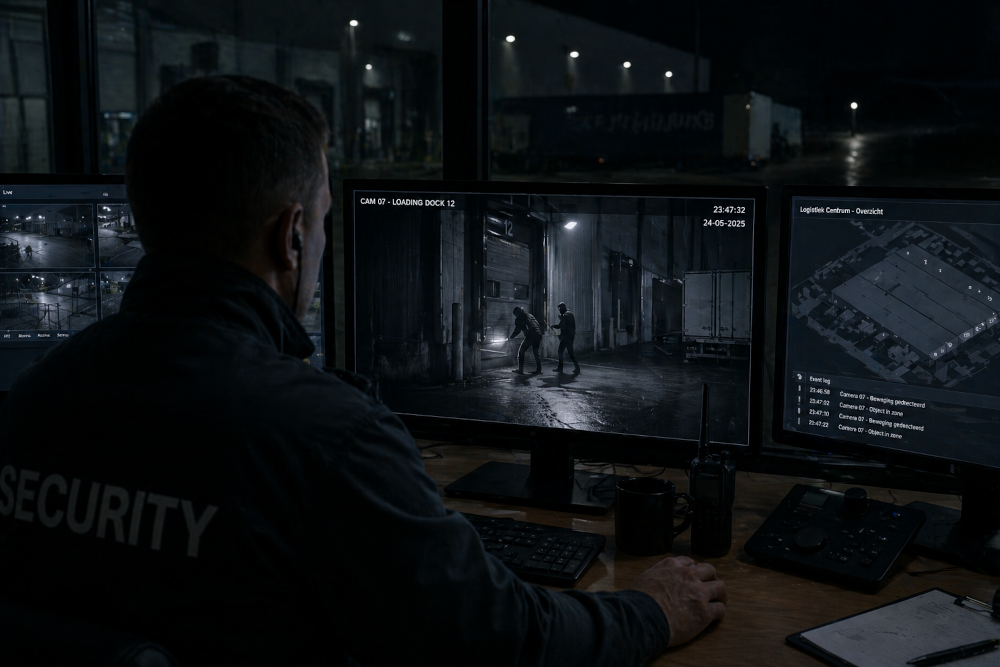
Back at the monitoring station, he checks the camera feeds as part of his standard routine. Camera seven, covering the loading bay at the rear of the building, shows movement. A shadow. Then a figure. Then two figures, working at the lock on the service door with what looks like a pry bar.
He does not rush toward the door. He has been trained not to. Instead, he activates his personal alarm device. A single press. The alert fires immediately.
Within seconds, the control room receives a priority notification. The system shows his identity, his current location within the site, and a timestamp. The operator on duty does not need to call him first to establish what is happening. The alert carries context. The operator calls the emergency services directly, reporting a break-in in progress at the confirmed address. Then the operator contacts the second night watchman at the nearby site, who begins making his way over.
The first guard keeps visual on the two intruders via the camera feeds. He stays in the monitoring room, maintaining contact with the control room through two-way audio. The system keeps the communication channel open. There is no fumbling with phone calls, no dropped connections. The guard knows help is coming. The operator knows the guard is safe and stationary.
Reliable connectivity is the backbone of this entire sequence. In warehouse and industrial environments, mobile signal can be patchy. Purpose-built SIM and connectivity infrastructure keeps the alert channel live throughout the incident, regardless of the building’s structural interference or network congestion at that hour.
The second guard arrives and parks outside the perimeter. He does not enter. Both guards maintain their positions, keeping visual contact with the intruders from safe distances. The police arrive eleven minutes after the initial alert. The intruders are apprehended at the scene. Neither guard sustained any injury.
From first alert to police arrival, the entire response chain worked because every part of it was connected. The guard, the control room, the second guard, and the emergency services all had what they needed, when they needed it. That coordination did not happen by accident. It happened because the underlying personal alarm system was built to manage exactly this kind of escalating incident.
Why This Use Case Exposes a Gap in Most Security Offerings
What this scenario makes clear is that a night security guard safety alert is not simply a panic button. It is a chain of events that depends on fast notification, accurate location data, reliable communication, and a control room that can act decisively. Each link in that chain has to hold under pressure.
Many security companies currently provide some version of this. They issue guards with mobile phones. They have an emergency contact number. They brief staff on lone worker protocols. But there is a meaningful difference between a protocol that exists on paper and a system that executes reliably at 02:47 when two people are trying to break into a building.
The specific gaps tend to emerge in three places. First, alert speed: a phone call takes time that a single-press alarm device does not. Second, location accuracy: telling a control room “I’m at the warehouse” is not the same as a system that shows exactly where within a site a guard is positioned. Third, documentation: a connected alarm system creates a timestamped record of every event in the incident chain. A phone call creates nothing.
For security company owners considering how to close this gap, the question is not whether their clients need this capability. The question is whether they can deliver it themselves or whether they are currently relying on third-party providers, or worse, leaving it unaddressed entirely.
How White-Label Personal Safety Infrastructure Changes the Business Casenight security guard safety alert
This is where the conversation shifts from operational to commercial. A security company that can deliver a white-label personal safety platform under its own brand is doing something fundamentally different from a company that sells guard hours and a mobile phone policy.
The guard in the scenario above was carrying a device managed and monitored by his employer’s own branded system. The control room operator was working within that same platform. The client organisation, the warehouse owner, was receiving a managed service from a single provider who owned the entire value chain. That is a significantly stronger commercial position than being one of three suppliers the client manages separately.
For a security company owner, this translates directly into recurring revenue. A monitored personal alarm service generates monthly income per device. It does not scale linearly with labour costs in the way that guard contracts do. As client headcount grows, a well-structured platform absorbs that growth without proportional operational complexity. Device management infrastructure designed for security deployments allows operators to onboard new sites, manage device assignments, and monitor usage across multiple clients from a single interface, without it becoming an administrative burden.
The competitive dynamic matters here too. A client who has their night security guard safety alert infrastructure integrated with their broader security service is not an easy client to move. The switching costs are real. The relationship deepens. And competitors stop getting calls.
The European market is growing at roughly 24% between now and 2029. That growth is happening whether individual security companies participate in it or not. The ones who can say yes to lone worker alarm monitoring, who can quote it, deploy it, and support it under their own brand, are the ones capturing that revenue. The others are redirecting those conversations to someone else.
What Your Night Security Clients Actually Need to Feel Safe
It is worth being direct about what the end client in this scenario actually experienced. The warehouse owner contracted a security company to protect their facility. That night, when two people attempted a break-in, the guard on site responded calmly, stayed safe, and the police arrived in time to make an arrest. The property was not damaged. No staff were harmed. The system worked exactly as it should.
From the client’s perspective, that outcome is the product. Not the device. Not the platform. Not the monitoring protocol. The outcome: their site was protected, their guard was safe, and the incident was resolved professionally.
When security company owners present lone worker alarm monitoring to clients in this sector, the conversation should focus on that outcome. The technology is the enabler. The control room is the enabler. But what clients are buying is confidence that when something happens at 02:47, there is a system in place that responds faster, more reliably, and more professionally than anything improvised could manage.
Night security guard safety alert capability also carries an increasingly important compliance dimension. Duty of care obligations for lone workers are tightening across European jurisdictions. Clients who rely on security companies to manage this risk are looking for providers who can demonstrate documented, auditable incident response. A connected alarm platform provides that record automatically.
The conversation is not a hard sell. It is a straightforward extension of the service the client is already relying on. When presenting this to security clients, emphasise the continuity of protection, the documented response chain, and the fact that their guards can focus on staying safe rather than managing a crisis on a mobile phone.
Frequently Asked Questions
What makes a personal alarm system suitable for night security guard use?
A suitable system needs to combine fast, single-press alert activation with reliable connectivity, accurate location reporting, and a monitored control room that can act immediately. In warehouse and industrial environments, connectivity resilience is particularly important. Standard mobile infrastructure can be unreliable in large buildings. Purpose-built SIM and connectivity solutions address this directly, keeping the alert channel live throughout an incident.
How does lone worker alarm monitoring differ from just giving guards a mobile phone?
A dedicated lone worker alarm monitoring system creates a structured, documented response chain that a mobile phone cannot replicate. Alert speed is faster, location data is more precise, and the control room receives actionable information immediately rather than waiting for a guard to make a call. Critically, the system creates a timestamped audit trail of every event, which is essential for compliance and incident review.
Can a security company offer this service under its own brand?
Yes. White-label personal safety platforms allow security companies to deliver monitored alarm services under their own brand, without building the underlying technology themselves. This means the client relationship stays with the security company, the platform carries the company’s identity, and the operator maintains full control over the value chain from device to monitoring to response.
What happens if a night watchman is in a building with poor mobile signal?
Signal reliability in industrial environments is a known challenge. Deployments that use dedicated connectivity infrastructure, rather than relying on standard consumer SIM cards, maintain alert and communication channels even in low-signal or high-interference locations. This is a practical consideration that should be addressed during any site assessment before deployment.
Is there a market for this service beyond large warehouse or industrial clients?
The lone worker safety solutions market in Europe covers care, retail, facilities management, construction, and security. The same underlying platform that supports a night watchman at a warehouse can serve a community care worker doing home visits or a retail manager closing a store alone. For security companies, this means a single service infrastructure can generate recurring revenue across multiple client sectors.
How quickly can a security company deploy this kind of service to clients?
Deployment timelines vary depending on platform choice and client complexity. White-label platforms designed for security integrators are built to move quickly. A realistic timeline for getting the platform live and onboarding a first client is typically a matter of weeks rather than months, particularly when device management and connectivity infrastructure are included as part of the solution rather than sourced separately.