

How to Build a Lone Worker Safety Programme: A Step-by-Step Guide for HR Managers
If you need to build a lone worker safety programme and have no dedicated safety team behind you, you are not alone. Across Europe, HR managers in mid-sized businesses are taking on this responsibility every day. This guide walks you through five practical phases, from risk assessment to continuous audit, so you can create a programme that protects your people and satisfies your regulatory obligations.
Phase 1: Conducting the Lone Worker Risk Assessment (Identifying the ‘Who’ and ‘Where’)

Every effective lone worker safety programme starts with a clear picture of your workforce. Before selecting tools or writing policies, you need to know who works alone and under what conditions.
Map your lone workers first
Start by listing every role in your organisation where an employee works without direct supervision. This includes field engineers, community healthcare workers, retail staff on early or late shifts, and delivery drivers. Do not assume office-based roles are exempt. Hybrid workers visiting client sites alone also qualify.
Assess the specific hazards
For each role, document the hazards present. Consider physical location, time of day, industry sector, and the nature of the work. A utility engineer in a remote substation faces very different risks from a housing officer conducting a home visit in an urban area.
A useful lone worker risk assessment covers four dimensions:
- Environment — remote locations, poor connectivity, confined spaces
- Activity — manual handling, working at height, operating machinery
- People risk — contact with vulnerable individuals or members of the public
- Time factors — out-of-hours working, long shifts without check-in
The EU Framework Directive 89/391/EEC already requires every employer to assess workplace risks, and national laws build on it. For lone workers that makes the risk assessment more than good practice. It is a legal duty.
Phase 2: Drafting a Clear Working Alone Policy (Defining Rules and Responsibilities)
Once your risk assessment is complete, translate its findings into a written working alone policy. This document defines who is responsible for what, and it sets the standard against which you will later be audited.
What your lone worker policy must cover
A strong lone worker policy template includes the following sections:
- Scope — which roles and activities fall under the policy
- Responsibilities — HR, line managers, and the lone workers themselves
- Communication requirements — mandatory check-in intervals and escalation steps
- Emergency procedures — what happens when a worker does not check in
- Technology requirements — what devices or apps workers must carry
Keep the language simple. Your lone workers will need to read and sign this document. Avoid legal jargon.
Assign named owners
Every policy needs a named person responsible for each action. Without named owners, accountability dissolves quickly. Assign a line manager as the first point of contact for each lone worker group. Define who monitors check-ins and who escalates to emergency services.
Phase 3: Selecting the Right Technology Stack (Apps, Trackers, and Man-Down Detection)
Technology selection is where many HR managers feel out of their depth. The market is crowded, and the terminology can be confusing. Focus on four core capabilities.
The four capabilities your working alone safety solution must have
- Real-time GPS location — you need to know where your workers are at all times
- Automated check-in and missed check-in alerts — manual check-ins get forgotten
- SOS or panic button — a fast, accessible way to raise an alarm
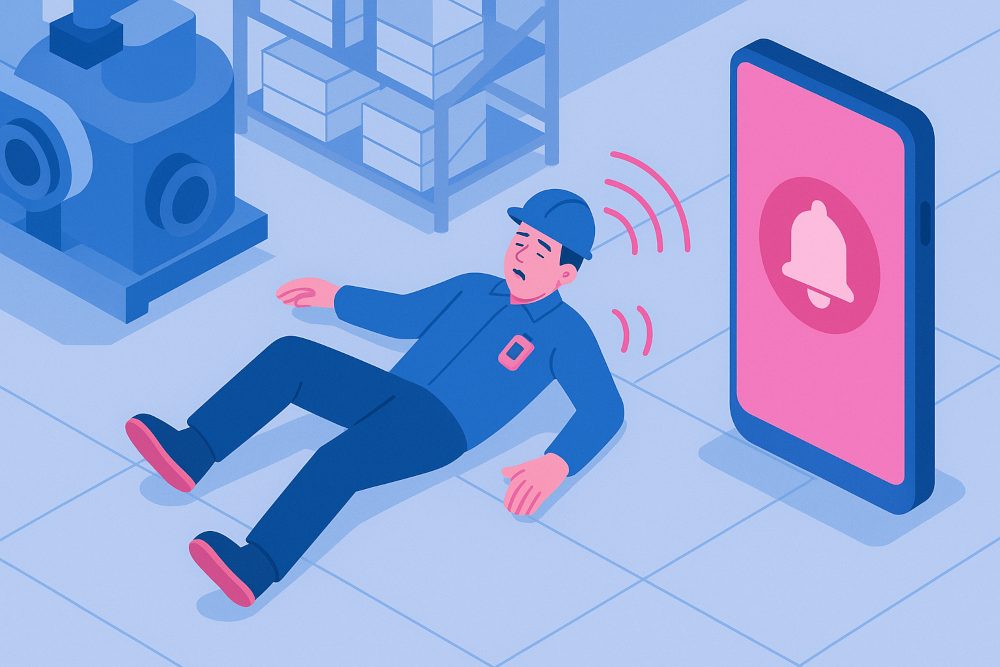
- Man-down detection — automatic alerts triggered by a fall or loss of movement
That fourth capability is the one most organisations underestimate. To understand why it matters, read about man-down detection capabilities and how they differ from a standard panic button. In short, an injured worker cannot always press a button. Automatic fall detection closes that gap.
Physical attacks on lone workers have risen sharply in recent years. According to the EcoOnline Lone Worker Landscape Report, 20% of reported lone worker incidents in 2024 involved violence, aggression or abuse, up from 11% in 2021. Your technology choice needs to reflect this reality.
For a broader view on how personal trackers and integrated platforms fit together, see how organisations can enhance lone worker protection across different environments and risk profiles.
Why man-down protection cannot be optional
Some buyers treat man-down detection as a premium add-on. It is not. If a worker suffers a medical episode, a fall, or an assault, they may be incapacitated within seconds. For a direct argument on this point, the article on why man-down protection is non-negotiable sets out the case clearly.
Evaluating platforms
When assessing vendors, ask these specific questions:
- Does the platform integrate with an Alarm Receiving Centre (ARC) for 24/7 professional monitoring?
- Does it support both app-based and dedicated device deployments?
- Can it handle indoor positioning with beacons for workers in large buildings?
- Does it offer over-the-air device configuration, so management overhead stays low?
Cuebly, for example, supports real-time tracking, device configuration, indoor positioning with beacons, and direct ARC integration. It also offers white-label deployment for organisations that want a branded safety environment. These are the operational details that separate a scalable platform from a basic tracking tool.
Phase 4: Implementing Staff Training and Change Management
Technology only works if your workers use it correctly. This phase is where many programmes quietly fail.
Train in two layers
First, train line managers. They need to understand the monitoring dashboard, know how to respond to a missed check-in, and be confident escalating to emergency services. Second, train lone workers themselves. Keep this training short, practical, and role-specific.
A 30-minute in-person or video session covering three things is enough to start:
- How to activate the device or app before a lone working session
- How to trigger a manual SOS
- What to expect if the system triggers an automatic alert
Address the trust concern directly
Some workers worry that location tracking means surveillance. Address this head-on. Explain that tracking is active only during working hours and is there to protect them, not monitor their performance. Share the policy document. Give workers a chance to ask questions.
Phase 5: Establishing an Audit Cadence and Continuous Improvement Loop
Building the programme is not the end of the process. You need a regular review cycle to catch gaps, incorporate new hazards, and stay aligned with regulation.
Set a minimum audit schedule
- Monthly: Review missed check-in logs and alarm events. Look for patterns.
- Quarterly: Assess whether any new roles or activities should fall under the policy.
- Annually: Conduct a full risk assessment review and update the policy document.
For the operational side of monitoring, the guide on lone worker safety tracking provides useful context on how real-time insights and automated alerts support ongoing oversight.
Use data to improve
A good platform generates incident reports, response time logs, and usage data. Use this data in your quarterly reviews. If a particular team consistently misses check-ins, that is a training or usability issue worth solving before it becomes a safety incident.
Ready to put your programme into practice? Explore how the Cuebly platform supports every phase of a lone worker safety programme, from real-time tracking to ARC-integrated monitoring. Get in touch with the Cuebly team to see how it works for your organisation.
Further reading
Frequently Asked Questions
A lone worker risk assessment is a structured review that identifies which employees work without direct supervision and what hazards they face. Any European employer whose staff work alone, whether in the field, at client sites, or during out-of-hours shifts, is required to conduct one. Under the EU Framework Directive 89/391/EEC and national law, this assessment is a legal duty, not just best practice.
A lone worker policy template should define which roles fall under the policy, set out the responsibilities of HR, line managers, and workers themselves, specify check-in intervals and escalation steps, and detail the technology each worker must use. The document should be written in plain language, reviewed annually, and signed by all relevant employees. Named owners for each responsibility are essential for the policy to function in practice.
Focus on four non-negotiable capabilities: real-time GPS tracking, automated check-in alerts, an SOS panic button, and man-down detection. Beyond features, check whether the platform integrates with a 24/7 Alarm Receiving Centre, supports both app and dedicated device deployments, and can scale as your workforce grows. Platforms that offer indoor positioning and over-the-air device configuration reduce ongoing management overhead significantly.
A panic button requires the worker to press it deliberately to raise an alert. A man-down alarm triggers automatically when the device detects a fall, sudden impact, or prolonged lack of movement. For lone workers who may be incapacitated by an accident or medical event, man-down detection is the critical layer of protection, because an injured worker cannot always reach a button.
Lone worker duty of care in Europe is grounded in the EU Framework Directive on Health and Safety at Work, which sets minimum requirements all member states must implement. Individual countries may apply stricter national rules on top of this baseline. In practice, duty of care means employers must assess the risks faced by lone workers, put appropriate controls in place, provide suitable technology, and maintain records. National laws add sector-specific rules on top.
Demo
Offer this to your clients, under your own brand
In a demo we show the platform and the app, with a situation from your own clients.
Keep reading
Related articles

Safety Insights
Lone worker app or dedicated device: which is right?
A lone worker app turns a smartphone into a personal safety device. A dedicated device is a separate…

Safety Insights
Lone Worker Safety Utilities Sector Europe: What Field Teams Need in 2026
Utilities field teams in Europe face unique hazards, from live electrical infrastructure to public contact risks. As regulatory…

Safety Insights
Violence Against Lone Workers Industry Risk: Which Sectors Are Most Vulnerable
Violence against lone workers industry risk is rising sharply, with 20% of incidents in 2024 involving aggression. This…